
Review: The Willows
Only 24 are invited to dine with the Willows. The question is will all 24 survive?
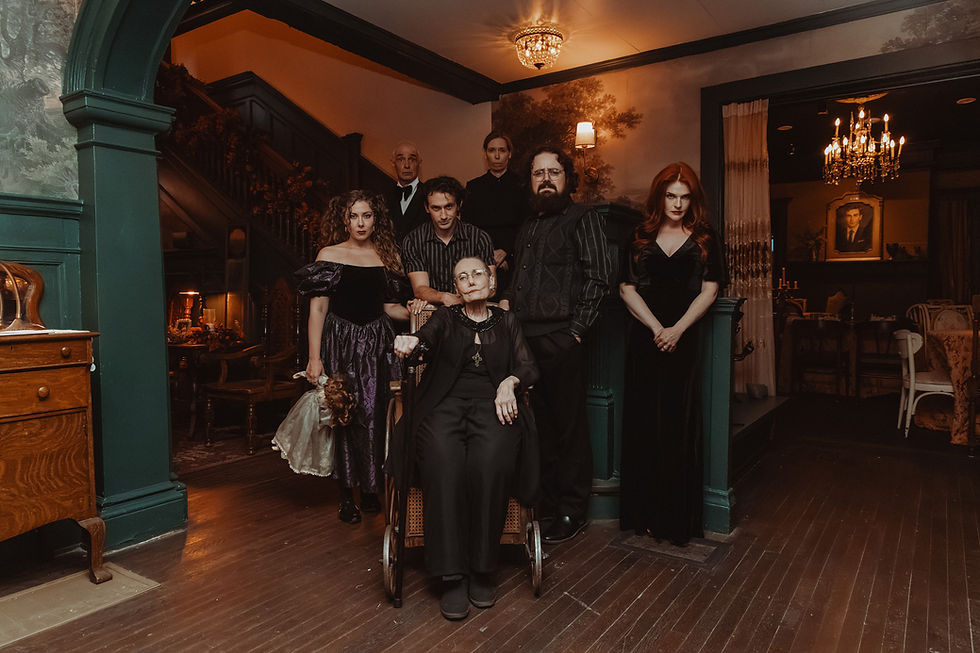
A full six or seven hours after witnessing the 2025 iteration of The Willows, I woke up in a jolt, my head full of thoughts, more questions really, about what I’d witnessed the night before at the historic Beckett mansion in West Adams. I thought I’d left the show behind when we were quickly ushered out of the production after a nearly two-hour dinner party/immersive theatre experience, but clearly the show hadn’t ended for me yet. Perhaps that’s the enduring power of The Willows, it just doesn’t release you until it’s quite ready to do so, if ever. So, at 5:00 AM in the morning this review begins.
Clearly, you don’t want to anger the matriarch of the Willows family, Rosemary, particularly tonight when she and her curious clan have summoned you and 23 others to their mansion to honor her late son Jonathan - a man seemingly admired deeply by all in the family and to whom the dowager demands respect and proper tribute. Over the next two hours that you’ll spend with this curious clan you’ll be educated, masticated and intellectually stimulated with information, family background and possible clues behind what you’ll learn was a great tragedy in the Willows family history. Early on at supper the soup is excellent, the conversation with the family lively, eventually disturbing, and you begin to sense that the Willows themselves are a clan Freud would have had a field day with.
“Get your elbows off the table!” bellows Rosemary. Before now, the lady of the house was only a bit severe, quietly eyeing her guests as she welcomed them to the night’s festivities. A short time later she’s slipping not-so-quiet opinions about her family’s shortcomings to me, apparently a longtime family friend, as I sit next to her. The other 23 “guests” sip and watch expectantly throughout the room. Each Willow member has their say in Act 1’s sup, each setting the table figuratively for what’s to come. But that elbows transgression induced rage, directed at another guest nearby who had forgotten his table manners has quieted the room. Better focus on my crudité and not at Rosemary for the moment. That poor guest was promptly led out of the dining room by Lindsay, the taciturn family butler who has clearly been handling the bizarre Willows goings-on for years. He assiduously protects and does much of the dirty work for his demanding boss, and he has a bit of a temper himself. Earlier, he’d chastised the gathering guests for daring to gossip as he organized them in line for entry to the dining hall. “Not a chatty time!” he sternly reprimanded.
Post-elbows conflict, conversation begins to rise again in the room, and I watch and listen to many of the characters from the Willows family that we’ve met and interacted with earlier as the story, er, evening began. Most prominent to me is Conrad, the man-child artist of the family – a sweet and somewhat manic presence who has been my mini-group’s guide for the first portion of the show. The show’s two-dozen guests are split up shortly after arrival at Beckett and put into smaller factions (say 4-5), thereby experiencing much of the proceedings from their own intimate perspective led and influenced by one of the seven cast members. Everyone, however, comes back together at key points in the evening and may have a brief opportunity to ask each other or even the Willows family members about what’s been happening in other rooms beyond one’s own view. If you inquire of the cast, er, Willows themselves, the response may be illuminating, vague or even laughed-off according to the nature of your query. The Willows don’t share all of their secrets after all.
Throughout the course of this moving play you aren’t just led through the periphery of it as so many immersive experiences are wont to do. Here, as a very inside guest of the Willows, you are an important part of the narrative. You’ll participate in and influence what happens and over dinner even help tell the story of the dearly departed. It’s heady and involving stuff and the more you play the more you’ll get out of the proceedings. You might, however, just have to come back six more times to realize the full scope of the tale.
So, trying to piece it all together, what you’ve seen, what you haven’t seen, if and who you’ve gotten to hear from of your fellow guests, characters in the play, or even from someone writing a review of the show, is somewhat in vain. Questions will remain and maybe wake you in the night. You do know this, though. You’ve seen something special.

There’s a reason The Willows is the most expensive ticket in town. It’s a high-end, fully immersive experience with quality elements across the board. The small cast is fantastic to a person and committed to their roles at a level rarely seen in Halloween-season entertainment. Of course, one expects a higher-quality evening at a pricy theatrical presentation like this, and the Willows team do not disappoint. Perhaps five-minutes in you’ll forget the fourth wall altogether and willingly surrender to becoming part of this show, feeling in some strange way that you do know this peculiar family, that you did have a relationship with the departed son, whose spirit reportedly still inhabits the space. And it’s easy, really, when you are surrounded by a cast that looks at you, talks to you, and confides in you in the deepest ways. How far that goes often is in relation to how much you are willing to engage.
The production team led by director Justin Fix cleverly employs the multi-room mansion to maximum effect, somehow managing to keep the action moving with small groups in multiple rooms simultaneously while still bringing all of the guests together for the major and pivotal action. It’s surely a balancing act that must be different every night due to the crowd, the improvisation, how fast people sip the delicious soup or enjoy the copious wine. The two-hour production moves faster than expected, though you rarely feel rushed, pace being maintained by the actors who know how to keep you going when and where throughout the narrative. And kudos to those behind-the-scenes personnel who are no doubt watching over this all from the shadows. Lastly, let’s not forget the other star of the night, the historic Colonial Revival, Beckett Mansion. Beautifully furnished, perfectly art directed and lit in a way that could be present-day or late nineteenth century, it all results in a gothic atmosphere for a moving play that itself is both contemporary and timeless.
The challenge in analyzing a show like The Willows is that you can only see what you see. There are other unfolding scenes in numerous rooms (80% scripted/20% improv according to director Fix) that you will not be party to throughout the evening. An inquisitive mind will want to know what that scream was in the distance, or what that faint argument coming from the floor above is all about. Alas, you can’t be everywhere at once in the Beckett Mansion or in the Willows storyline, so perhaps future visits are needed to understand the full 360-version, and even then there will be fluctuations in the narrative that essentially means no two shows could ever be the same. This is why as a participating audience member at The Willows you should take any opportunity you can when given the chance to chat with other invitees about “who are you with, what did you see” to help flesh out the overall story. But do so quickly because you’ll soon be swept off into another room by one of the Willows family who will reveal yet more secrets, pleas and clues to the things still unknown.
There comes a moment late in this play as the denouement rushes in, when suddenly, without the use of one of your six senses, you are forced to confront the exploits of all that you have witnessed through a tunnel of limited sensory perception, and this powerful two-or three-minute period is the diamond of the night. Even if the ending after seems a bit rushed (there is another show that night, after all) that time shut off from your complete senses is a sensory highlight of an overall memorable experience. Then you are off into the night of West Adams, perhaps on to your next Halloween Scene Los Angeles adventure.
Rating: 4+ (of 5)
Tickets: $250.00
reviewed by Thom Mills
top photo credit: Max Baker
middle phot credit: JFI Productions


